 Translate
Why might employment coaching help people find jobs, keep jobs, and advance in their careers? The answer to this question involves understanding self-regulation skills. By clicking on the links below you can learn more about self-regulation skills and their role in coaching.
What are self-regulation skills? Self-regulation skills are used to stay organized, finish tasks, and control emotions. Other terms used to refer to these or related skills include soft skills, social and emotional skills, executive skills, and executive functioning skills.
How self-regulation skills affect employment. Getting a job, keeping a job, and advancing in a career requires using many self-regulation skills.
How poverty affects the use of self-regulation skills. Poverty and other sources of stress can hinder the development and use of self-regulation skills.
How self-regulation skills are related to coaching. Coaching is expected to help participants use and strengthen their self-regulation skills.
Impacts of coaching on self-regulation skills. This study showed that two programs impacted participants’ self-regulation skills.
Coaches and participants interviewed for this hub talk about self-regulation skills
Coaches talk about emotion regulation
Participants and a coach talk about time management
What are self-regulation skills?
Self-regulation skills are used to stay organized, finish tasks, and control emotions. Other terms used to refer to these or related skills include soft skills, social and emotional skills, executive skills, and executive functioning skills. It includes factors such as motivation as well as emotional regulation and cognitive skills. The table below provides more details.1
 Cognitive
Executive function: A person’s ability to regulate and control their actions, particularly intentional action and setting and pursuing goals
Selective attention: The ability to deal with one aspect of a task in the face of other thoughts, information, and actions
Metacognition: A person’s ability to observe and evaluate how they think, which is sometimes referred to as “thinking about thinking”
 Emotional
Emotion understanding: A person’s ability to understand emotions in themselves and others
Emotion regulation: The ability to alter the intensity of the emotion a person is experiencing and the behaviors that go along with that emotion
 Personality
Motivation: The inner drive to achieve a specific goal
Grit: The ability to persevere to attain long-term goals
Self-efficacy: The belief a person has in their ability to perform well
Back to Top ^
How self-regulation skills affect employment
Self-regulation skills are critical to getting, keeping, and advancing in a job. For example, people need to be motivated and believe in themselves to stay focused on a task despite setbacks. They must understand emotions and control their emotions to work well with coworkers or supervisors. The table below provides some examples.
| SKILL | EXAMPLES OF USING THE SKILL |
|---|---|
| Executive function | Determining which actions to take next to obtain a job or complete a work task |
| Selective attention | Not getting distracted when completing a task at work |
| Metacognition | Recognizing that based on your strengths, you need to read instructions about a task as well as hear them read to you |
| Emotional understanding | Understanding the needs of a co-worker, client, or supervisor |
| Emotional regulation | Staying calm when irritated by a co-worker, supervisor, or client |
| Motivation | Applying for a training course to facilitate entry into a desired career |
| Grit | Persevering when rejected after job applications |
| Self-efficacy | Believing in the ability to pass the exams necessary to obtain a training credential |
Back to Top ^
How poverty affects the use of self-regulation skills
Recent research suggests that the stresses and uncertainty of poverty can be overwhelming, leaving less mental bandwidth for effective use of self-regulation skills.2,3,4 Even people with otherwise strong self-regulation skills might find them difficult to use in times when they are facing material hardships and other sources of stress. For example, when someone is worried about how to pay their rent and avoid being evicted it is hard for them to plan out what they need to do to get a job or to stay calm when irritated by coworkers.
Participants interviewed for the study talk about challenges that inhibit using self-regulation skills

“I’m not always consistent, because…I have three kids, I'm a single mom. Yeah. That’s why all of my goals are not where they should be.”
– a MyGoals participant
“I do have anger management problems. I do have depression. I suffer from anxiety when I’m put in certain situations when I’m uncomfortable.”
–a FaDSS participant
Back to Top ^
How self-regulation skills are related to coaching
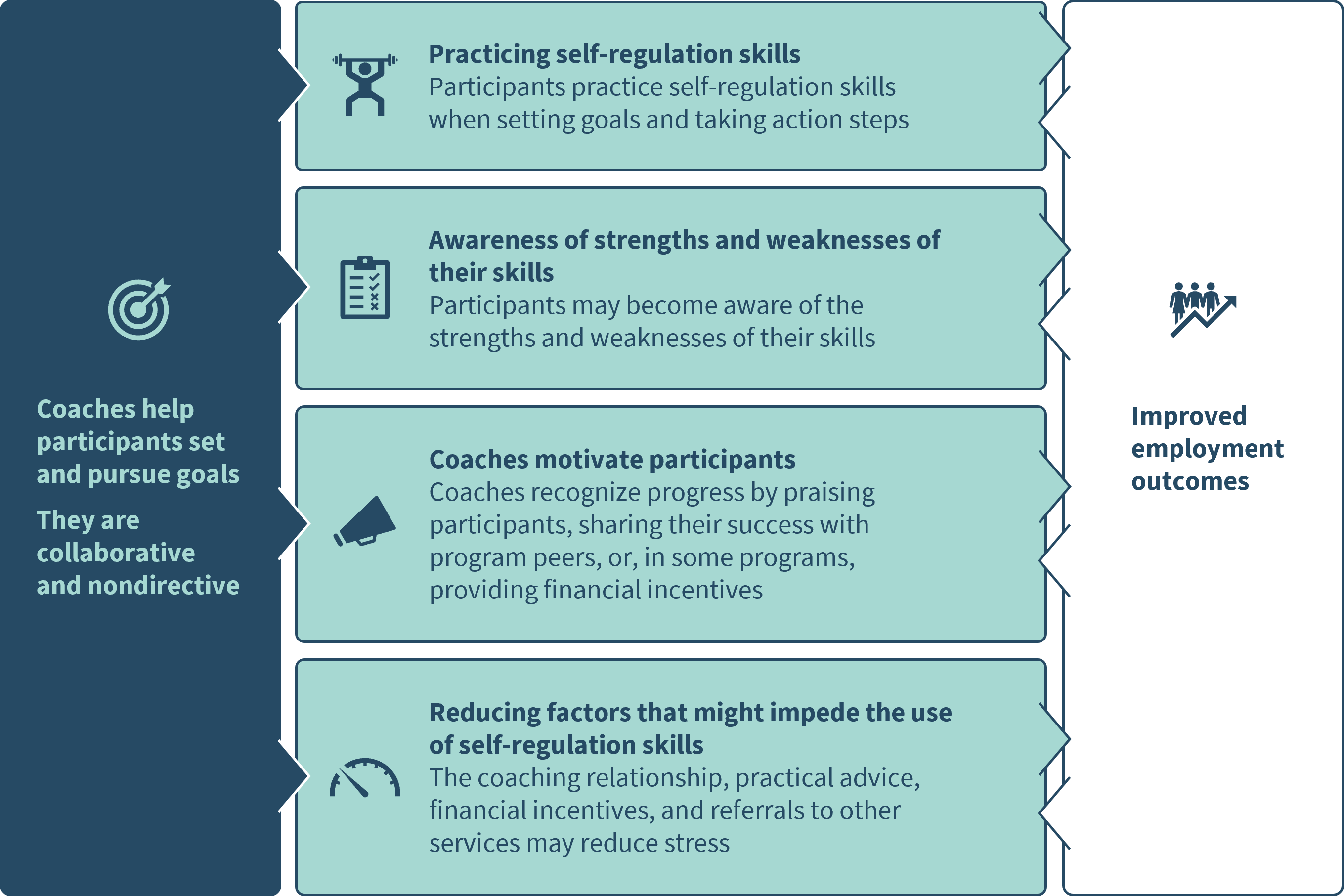
Coaching is expected to help participants use and strengthen their self-regulation skills. It does this in four main ways.
- Participants practice self-regulation skills as they set goals and take action steps toward the goals. As participants improve their employment outcomes, this success reinforces the self-regulation skills as well as providing more opportunities to practice them.
- Participants may become aware of their strengths and weaknesses in their self-regulation skills and this awareness may help them address problems that arise and choose goals, services, and jobs to match their self-regulation skill strengths.
- Coaches can motivate participants by asking about their progress and celebrating their successes.
- Coaches can reduce participants’ stress, which may allow participants to better use self-regulation skills. They can reduce stress by providing practical advice, linking participants to resources, and in some programs, by providing financial incentives. The development of a trusting relationship between coaches and participants also helps reduce participants’ stress.
A staff member interviewed for the study talks about celebrating participants’ successes
“It’s also about celebrating the accomplishments and the wins along the way that, often, people overlook just because they didn’t achieve that big goal yet, and so we make sure to also, in coaching meetings, celebrate our members, recognize how far they’ve come, and create that space where they feel like, okay, I have done things. I’m a little closer to my goal, so this is achievable, this is working, I want to come back to a coaching meeting, because it’s working”
–a LIFT staff member
Participants interviewed for the study talk about skills they learned
“I definitely told her that I get a little anxious, I get a little snappy so, she's helping me with little techniques you know, before you get too upset just breathe and, you know, if you feel like you’re in a situation and you just can't handle it, it's okay to get up and walk off. You don't have to address every single thing…So, as far as my attitude is concerned and dealing with situations, I definitely say that [my coach has] helped me with that because I be on edge.”
– a MyGoals participant
“Honestly, setting goals…like, you really underestimate the power of writing things down for yourself and like just having a structure. Like, the structure of that was really, really encouraging. I was like, oh, I grasp this.”
–a Goal4 It! participant
Back to Top ^
Impacts of coaching on self-regulation skills
For the study, we developed a set of survey questions to measure self-regulation skills related to setting and attaining employment goals. Go to the Impacts of Coaching section of the hub or this report to learn more about these measures.
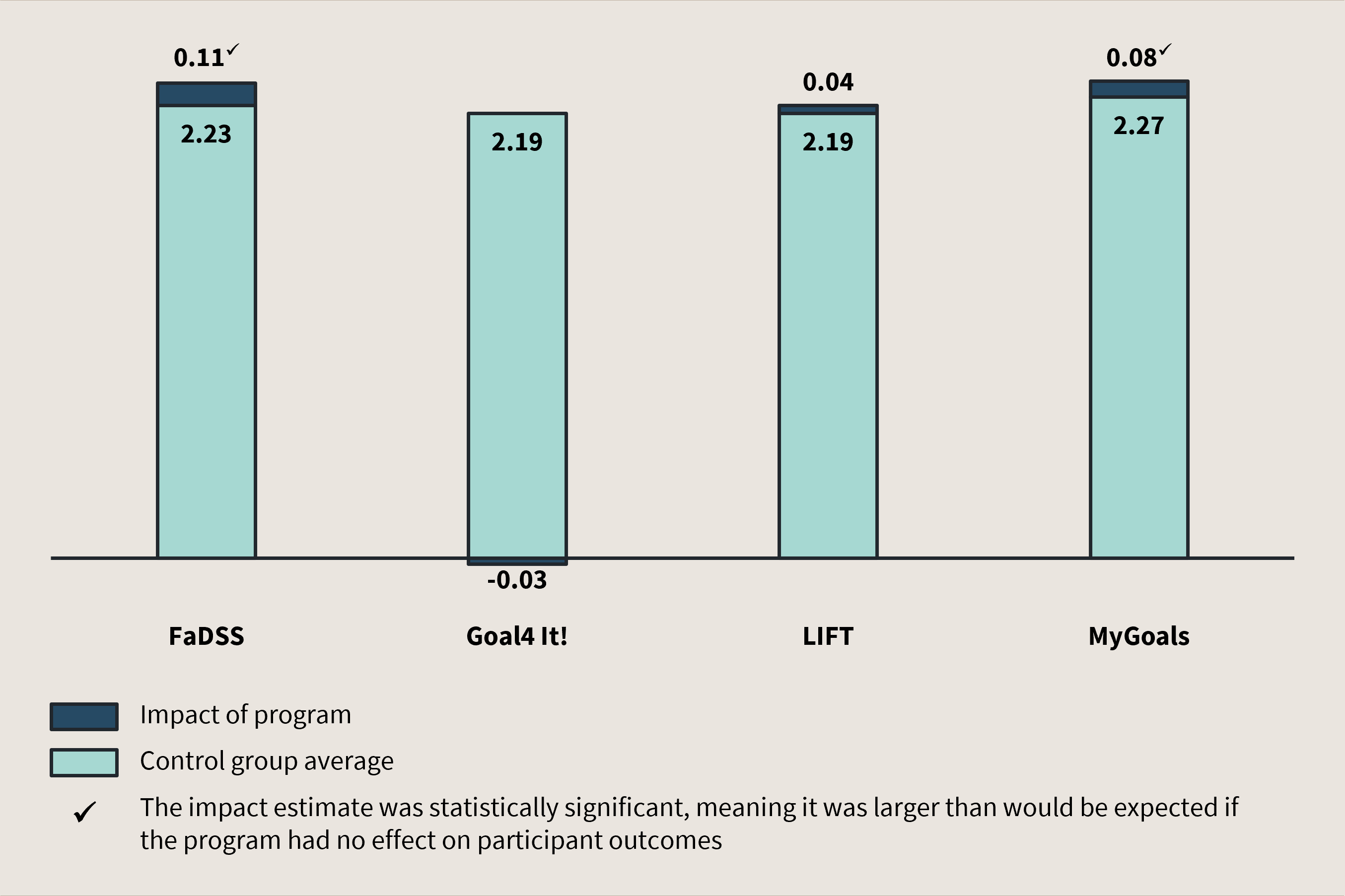
FaDSS and MyGoals—two programs that implement coaching in different ways—had positive and significant impacts on the study’s measure of goal-setting and attainment skills at 9 months and 12 months after study enrollment, respectively, as shown in the figure below.
- MyGoals featured a structured 12-step process to setting goals in which coaches explicitly assessed and discussed self-regulation skills with program participants. MyGoals had a positive effect on goal-setting and attainment skills at 12 months after study enrollment.
- In contrast, FaDSS involved less structure, giving the coach much more autonomy. In addition, FaDSS coaches were not trained on self-regulation skills and did not assess program participants for those skills or name the skills in discussion with participants. FaDSS also had a positive effect on goal-setting and attainment skills at 9 months after study enrollment.
- Goal4 It! used a structured 4-step process for setting goals. Coaches learned about self-regulation skills as part of their training, but did not assess or discuss them with participants. Goal4 It! did not have impact on goal-setting and attainment skills at 9 months after study enrollment.
- LIFT used a less structured process for setting goals. Coaches learned about self-regulation skills as part of their training, but did not assess or discuss them with participants.LIFT did not have impact on goal-setting and attainment skills at 9 months after study enrollment.
For information about the coaching programs in the study, go to the Meet the coaching programs section of the hub.
Impact of programs on goal-setting and attainment skills during the first follow-up period
Future follow-ups from this study may shed light on whether the impacts on goal-setting and attainment skills reflect a lasting change in skills or a temporary change in behavior. Program participants may set goals and practice self-regulation skills while in the program, but may not be able to continue those behaviors without the support of a coach. Analysis of data from future follow-up periods will allow investigation of this possibility.
Back to Top ^